

EN ESPAÑOL
An immersive curation. October 2 through November 1, 2026. By appointment only.
hRAD Gallery at 324 N 12st
About the curator, Pamela Nanét
I am a cultural curator, a dancer, and a transcultural marketing strategist, and I have spent most of my life moving between communities. I was born in Mexico City and grew up in Queens, New York. I spent long stretches in Florence, Chicago, and Oaxaca before settling here in Milwaukee for the second time. I am fully bilingual in English and my native Spanish, and I have learned that most of what matters in a family is said in the language people use at home.
For more than fifteen years I have worked in graphic design, marketing, brand communications, and event production. I studied at the Fashion Institute of Technology in New York, and I hold a master’s degree in museum and exhibition studies, with a concentration in social justice, from the University of Illinois Chicago. That training, together with my life experience, has shaped how I think. I design spaces that hold people, and then I ask what those spaces are saying, and who they are saying it to.
This is not my first exhibition. In 2015 I curated 43 Voices at Arts @ Large in Walker’s Point, a response to the disappearance of forty-three students from the Ayotzinapa teachers’ college in Guerrero, Mexico. Twenty-three artists from around the world showed their work next to twenty students from Reagan High School here in Milwaukee. I learned then that an exhibition can be a place to grieve out loud, and a place where the people who are usually talked about get to do the talking.
Home comes from the same instinct. It was built by local Milwaukee artists and a few friends, with no budget and limited marketing support. At the end of the show, on Mercadito Day, the furniture will be sold like an estate sale, and this house will be taken apart the way so many of our homes have been. I want you to carry that with you as you walk through. Thank you for coming.
HOME is not an exhibition hung on white walls. It is a home, built inside a gallery by Black and Brown artists, where the art lives with the furniture, the books, the table, and the bed. For many of our families, home is an archive, a survival strategy, a place to heal, and a place to imagine together. This show holds all of that. It asks visitors to take off their shoes and step inside, or to walk past on the outside path and watch, the way so many of us are watched every day.
A home is something you build, and it is also something that can be taken from you. We built this one with our own hands, our own furniture, and whatever we could find.
HOME is on view October 2 through November 1, 2026, by appointment only. To schedule a visit, email [email protected]. Opening Night was on October 2 and Gallery Night MKE will be October 16. On November 1, Mercadito Day, the furniture is sold like an estate sale, and the house comes apart.
Pamela Nanét. Your curator. Artistic direction, research, copywriting, spatial design, and bilingual audio tour.
Conhg Lopez Ausencio. Mixe artist from Oaxaca, working in woodblock printmaking and painting, based in Milwaukee for about twenty years.
Aida El-Hajjar. Palestinian American artist for whom art is both cultural preservation and resistance, celebrating Palestinian resilience against the forces that try to erase it.
Anthony and Louie Brewer. Father and son who use abstraction to express and connect. Anthony’s work captures quiet moments in chaos, a breath, a balance, a release. Louie’s follows what happens when you let the magic lead.
Ash Ernesto. Born in New York to Mexican parents and now living in the Midwest, Ash calls himself an observer, an absorber, and eventually, a storyteller. His embroidery carries forward the work of our grandmothers.
Nicole Acosta. Milwaukee-born, Mexican Indigenous photographer and painter, creator of the nationally recognized HOOPS Project, and the 14th Artist in Residence at the Pfister Hotel.
Shana Lucas. Quilter and writer whose great-grandmother made quilts from scraps of loved ones’ clothing. Shana works the same way, making beauty from cast-off material with history.
My Role and Process
I conceived, curated, and designed HOME, the first and only installment of Black & Brown Only in this building. I recruited the artists, designed the identity, planned the floor, wrote and recorded the bilingual audio tour, built the catalogue, and coordinated a volunteer install. Artists contributed their work, their labor, and personal objects from their own homes. My dad and my brother helped me build the entrance wall from cinder blocks and Cream City bricks borrowed from a pile by the train tracks.
I laid out the house using the feng shui bagua map, anchored at the front door. The library sits in the knowledge corner just inside the entrance, the bedroom falls in love and partnership, and the center of the house, where we gather, belongs to health.
DATES
Opening Night, Friday, October 2, 2026.
Gallery Night MKE, Friday, October 16.
Mercadito Day (closing), Sunday, November 1.
Curatorial Assistant: Ash Ernesto
About the Floor Plan
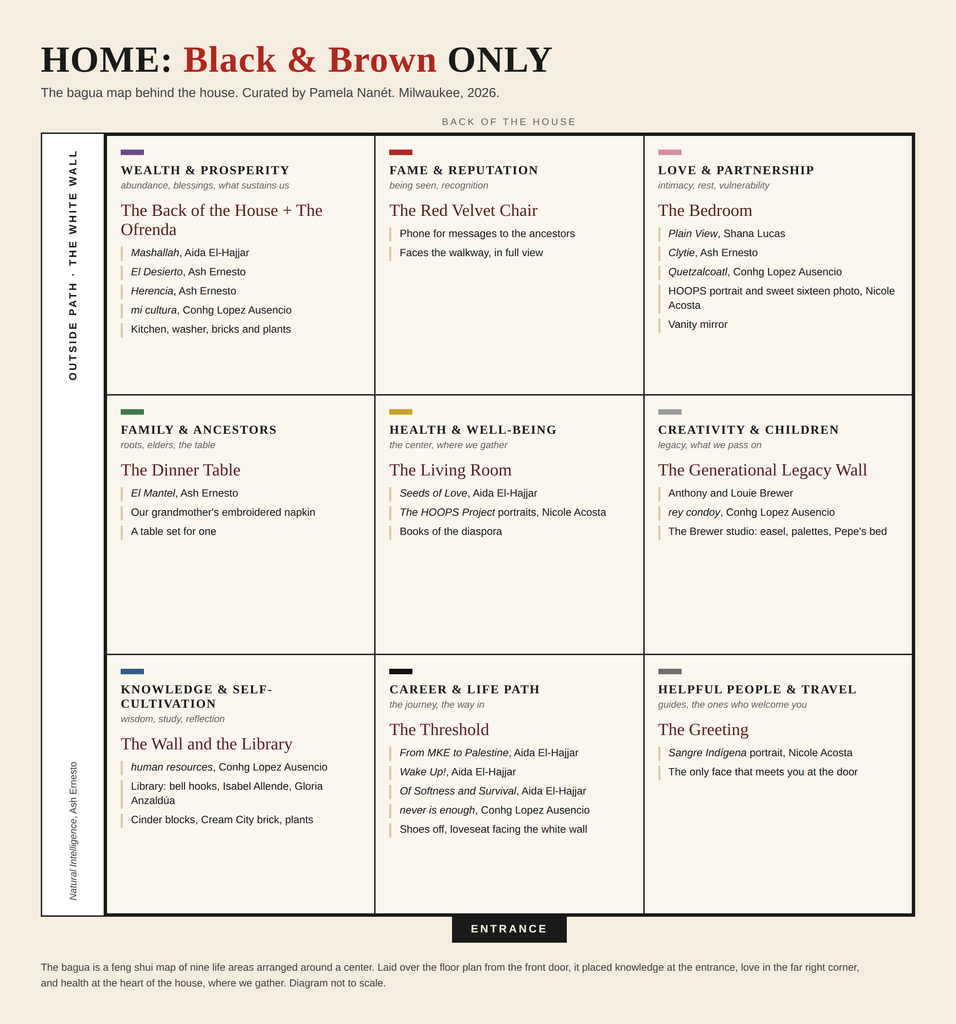
The Bagua
Photography is NOT permitted.

Two Ways to Walk the Space
Visitors can experience HOME in two ways:
Left – Walk the path along the white wall. Keep moving, and please do not cross over the bricks
Right – Take a seat, take off your shoes or put on shoe covers, and come inside.
What to Expect
The path to your left is for passing through. It lets you walk by without stopping and without holding up anyone behind you. It is also the way to the restrooms, so if you are just here for the bathroom, that is your path too.
The second way, to the right, is to come inside. Inside, the home is meant to be lived in. Some of the pieces are interactive. Some of them are furniture. You are invited to sit, to slow down, and to be present. Before you enter, you can take off your shoes or put on shoe covers. Either one is fine. What matters is the act. It gives you a minute to sit and prepare yourself the way you would before walking into someone’s home, with respect for the work and for the labor you are about to become part of.
Concept Behind HOME
Thoughts and themes to carry throughout your visit.
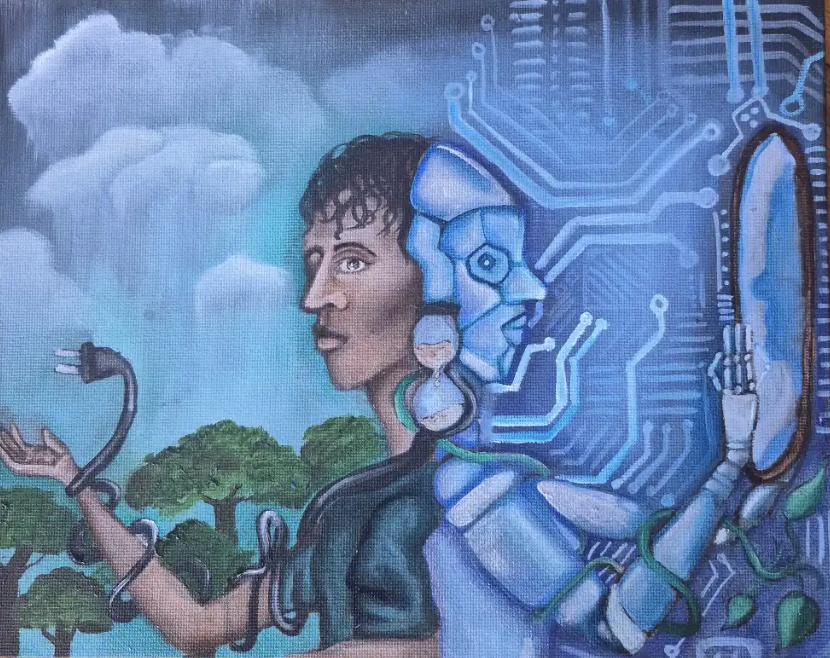
Natural Intelligence, 2026
Ash Ernesto. Oil on canvas, 10″ x 8″
Not for sale
About Natural Intelligence
Cinder Block Plant Wall
The entrance wall, built from cinder blocks, Cream City brick, and plants, holds the library, and a portrait that greets you at the door.

Christina, 2022
Nicole Acosta. Photography, 4″ x 7″
Not for sale
The Cinder Brick Wall
Now look to your left. This entrance wall is also our library. It is full of books by people of color, written for the diaspora: bell hooks, Isabel Allende, Gloria Anzaldúa, and many more. This corner is where the knowledge lives, and I mean that literally. In the feng shui map I used to lay out this house, the area just inside the door, on the left, belongs to knowledge and self-cultivation. There are books all through this house, and each one was chosen for the room it lives in.
The wall went through several iterations. My dad and my brother helped me with the cinder blocks and laid out the Cream City bricks, which came from a pile lying outside the building by the train tracks. We asked to borrow them.
The Threshold
Take a seat, take your shoes off, or grab a pair of shoe covers. A loveseat facing the white wall, and a question:
is it ever going to be enough?
If you take your shoes off, line them up beneath Aida El-Hajjar’s From MKE to Palestine. You and your shoes have now become part of the work. A row of shoes at a door tells you that someone is home. Empty shoes have also become one of the ways the world marks the people who are gone. Under this piece, they say both things at once.
The loveseat you are on rests beneath another of Aida’s paintings, Wake Up!: a woman crying, holding her child. Look at how the shape of the figures follows the outline of the loveseat under them. Look at the posture, too. If it feels familiar, it may be because it carries the memory of Michelangelo’s Pietà, carved at the end of the 1490s, where Mary holds the body of her son across her lap. The Pietà is probably the most famous image in Western art of a mother holding what she has lost. Aida gives us that same weight, that same anguish, in a mother who is not a saint in a basilica. She is someone’s mother. And the title is not addressed to her. She is already awake to her grief. It is addressed to us, and to everyone who keeps watching and walking past.
I placed you here, facing the white wall, on purpose. I am inviting you to literally sit with the reactions of the people passing by outside. Beside Aida’s work hangs Conhg Lopez Ausencio’s woodblock print never is enough. Conhg is a Mixe artist from Oaxaca who has made his life in Milwaukee for about twenty years.
His print speaks to Aida’s Of Softness and Survival, a work in felt that I read as a subconscious self-portrait, a figure caught in reflection. Look at that title: softness and survival, at the same time. Together these pieces ask a question I have asked myself many times.
Is it ever going to be enough, all this biting off more than we can chew?
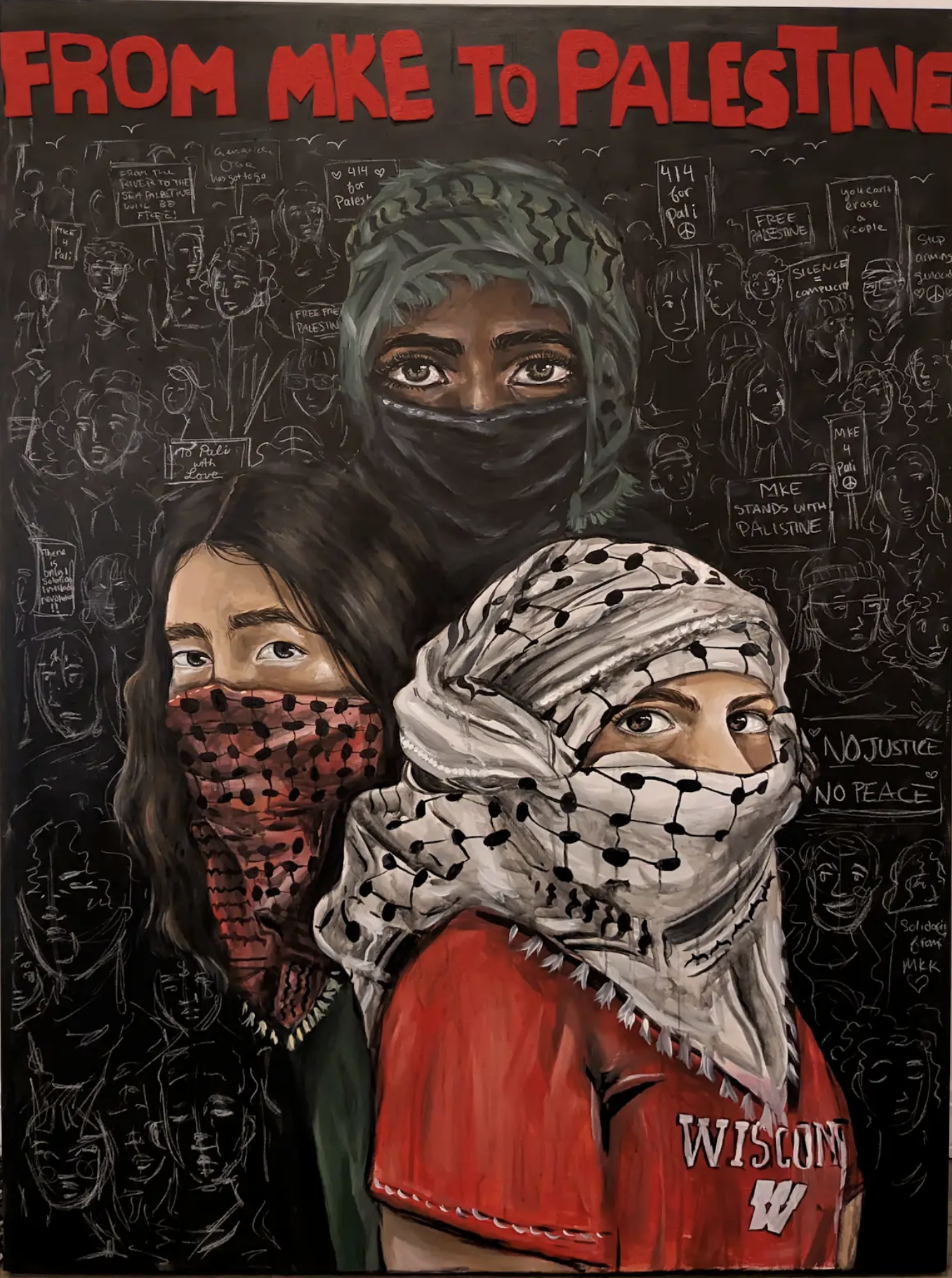
From MKE to Palestine, 2025
Aida El-Hajjar. Mixed media, 48″ x 36″
Not for sale
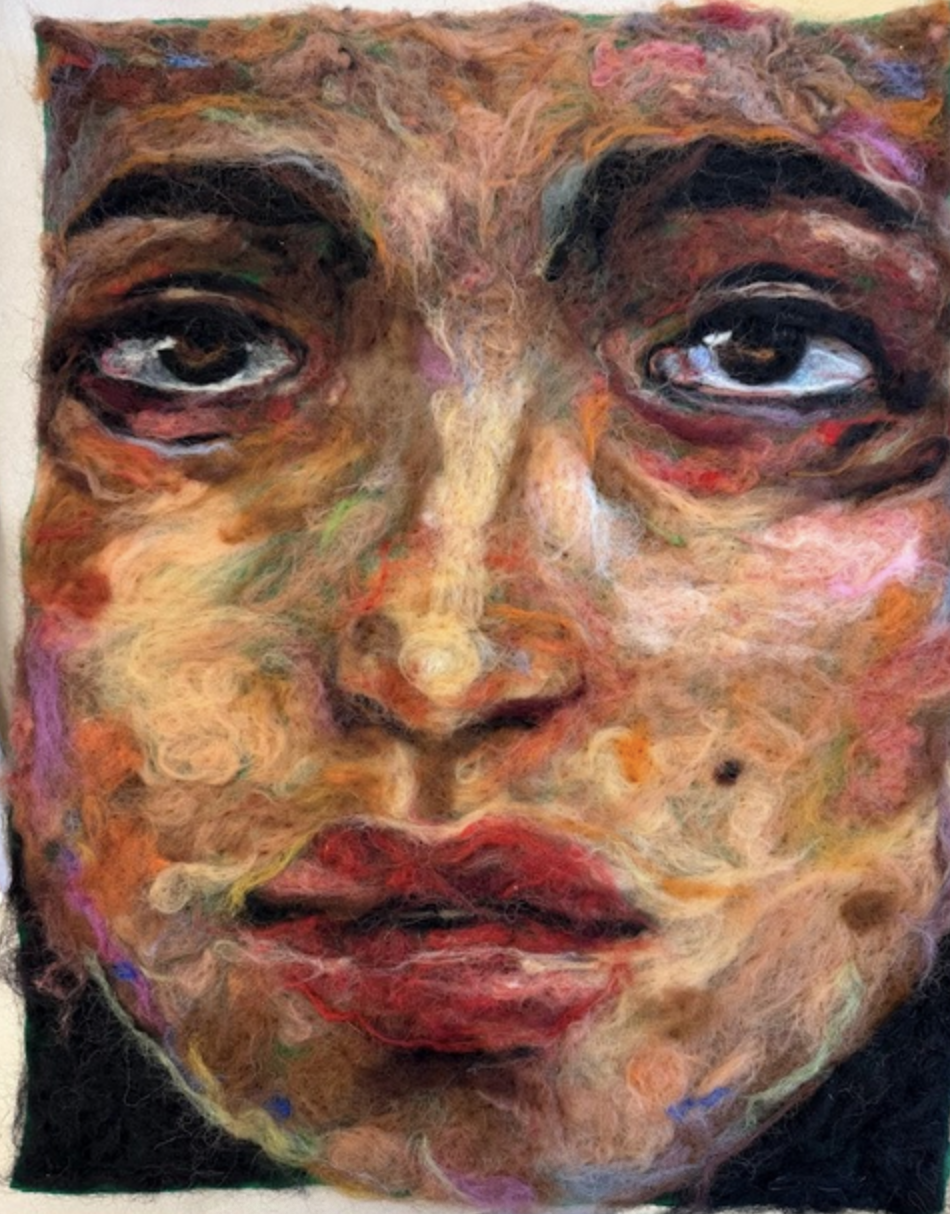
Of Softness and Survival, 2026
Aida El-Hajjar. Felt, 14″ x 19″
Not for sale
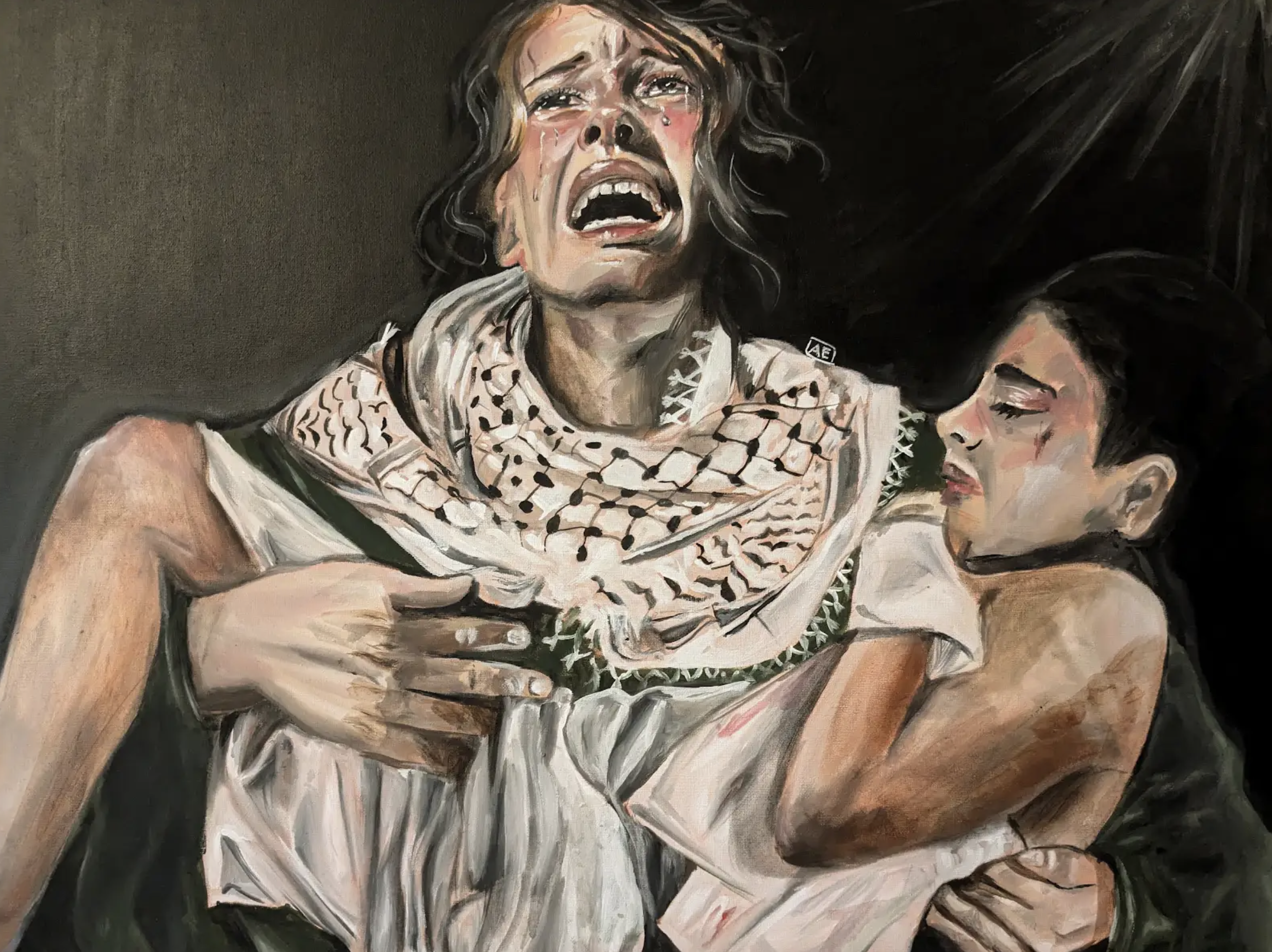
Wake Up!, 2024
Aida El-Hajjar. Acrylic, 24″ x 30″
Not for sale
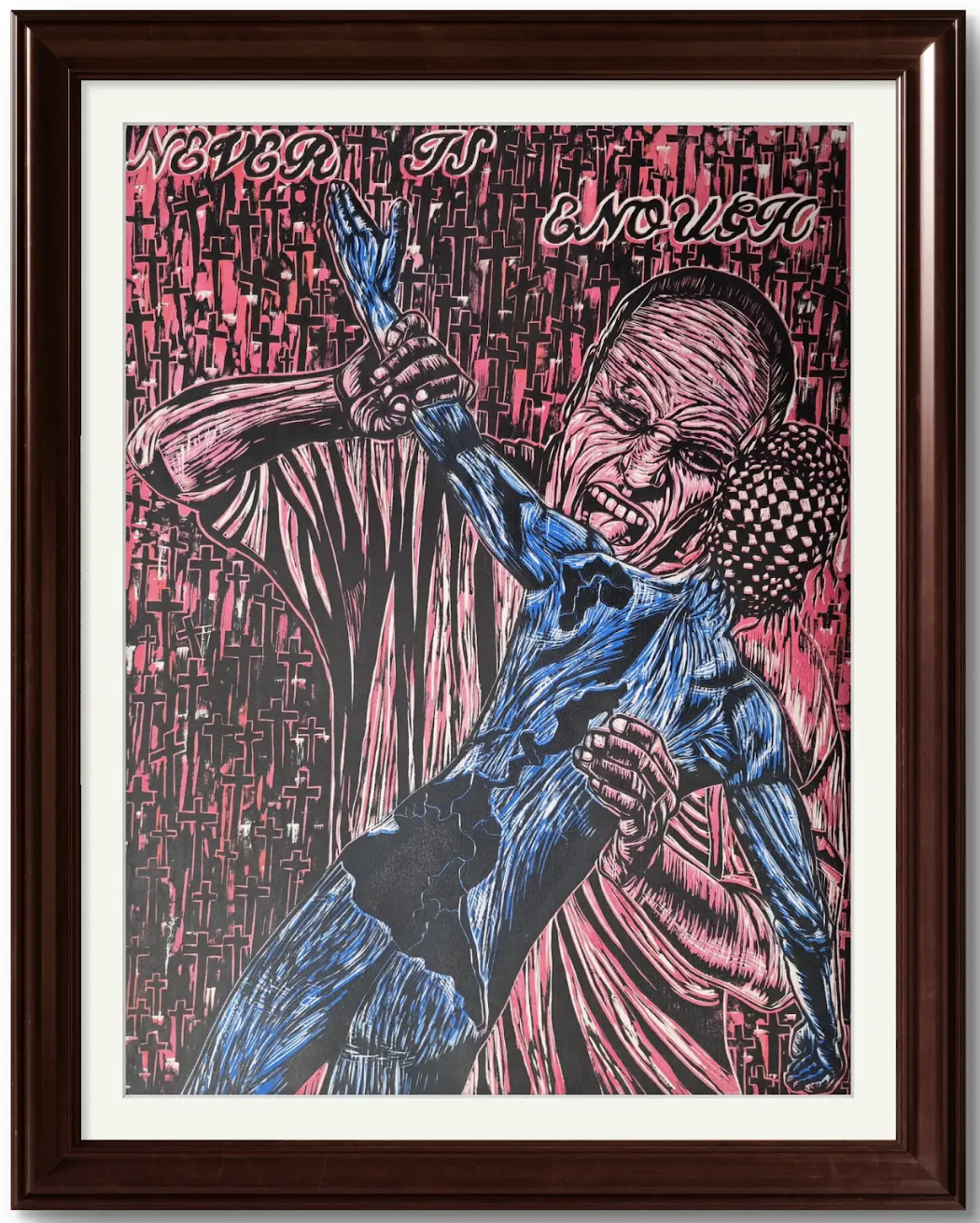
never is enough, 2024
Conhg Lopez Ausencio. Woodblock print on paper, 22″ x 28″
$450
Inquire: [email protected]
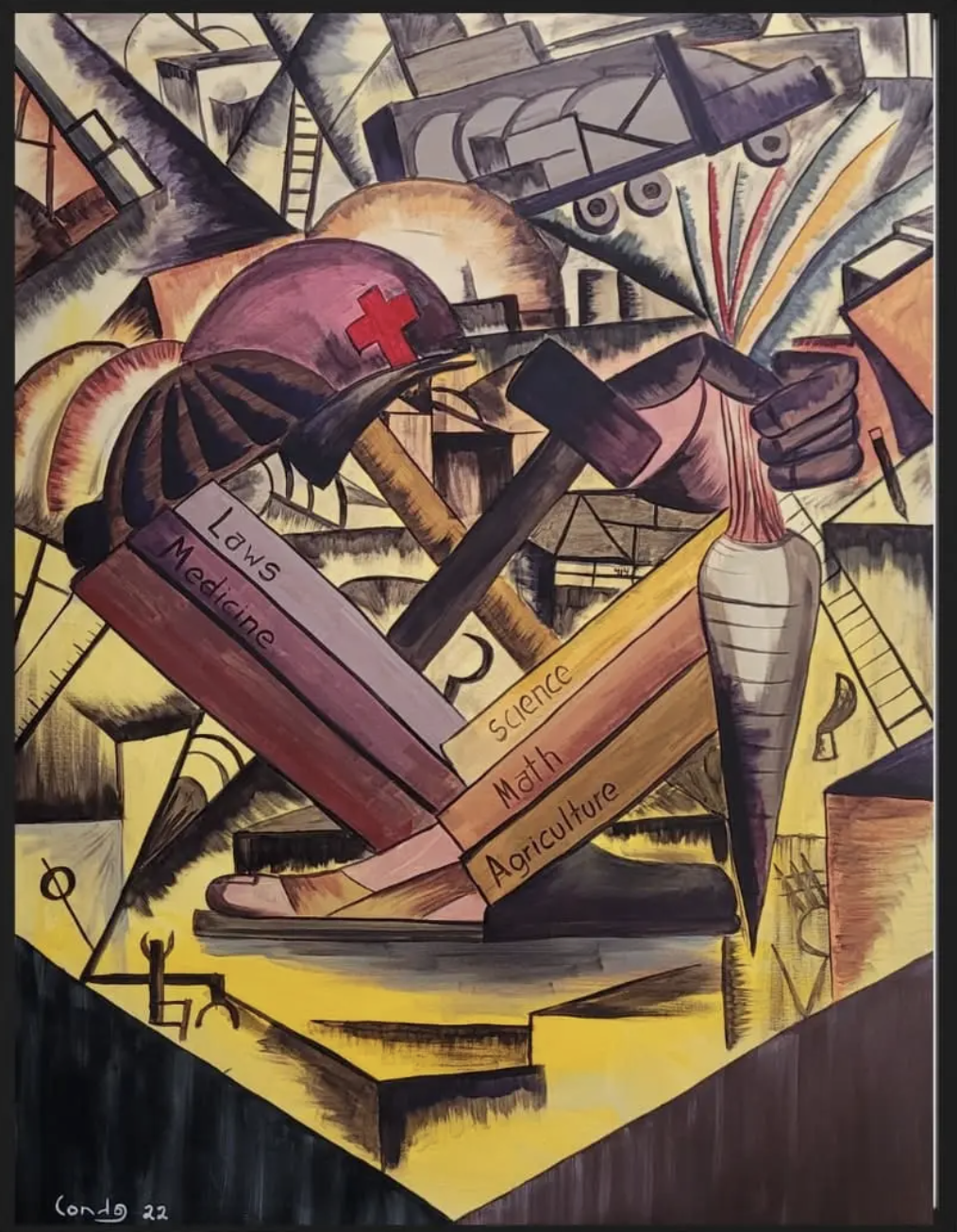
human resources, 2023
Conhg Lopez Ausencio. Acrylic on canvas, 32″ x 48″
$4,500
Inquire: [email protected]
Human Resources of Color in the Menomonee Valley
Human resources is the name of the office that turns people into labor, into headcount and output. Conhg answers that name with everything we actually carry. Books stamped Laws, Medicine, Science, Math, and Agriculture. A hammer. A hard hat beside a helmet marked with a red cross. Ladders, scaffolding, and machinery, and a raised fist pulling a root from the earth, with color bursting out of it. Hidden in the buildings, you can find 414, Milwaukee’s area code.
Now look at what it stands on. Cream City brick was made from the clay of the Menomonee Valley, the valley right outside this building, and it gave Milwaukee its nickname. This city was built out of it. But the people in this painting were mostly kept at the edges of what it built.
In 1920, the Pfister and Vogel tannery brought about a hundred Mexican workers to Milwaukee, first as strikebreakers. They were called los primeros, the first Mexican community in the city, and they settled in Walker’s Point. They were paid less than white workers and given the job of lowering hides into chemicals that burned their eyes, noses, and lungs. By 1930 the community had grown to more than four thousand people. When the Depression came, many were pushed to return to Mexico.
Black families came north in the Great Migration to work in Milwaukee’s foundries, tanneries, and factories, often in the hottest and most dangerous jobs. Housing discrimination held them inside a few blocks of the North Side, in Bronzeville. At the time, a prosperous black neightborhood. In the 1960s, freeways were cut straight through it, destroying homes and businesses and scattering the people who lived there. This same valley became a line between the Black North Side and the white South Side. In 1967, the NAACP Youth Council and Father James Groppi marched across the Sixteenth Street Viaduct, over this valley, night after night, for fair housing, and they were met by crowds throwing rocks and bottles.
So this painting stands literally on the city. People of color were and continue to be the human resources this country uses to build itself. That is the knowledge this corner holds.
Dinner Table
A table set for one, a red velvet chair, a cloth stitched with all four seasons, and a napkin embroidered by our grandmother.
Ash is deeply inspired by our grandmothers. Both of them used a needle and textiles to provide for their families. When our paternal grandmother passed away, our aunt knew my brother and I would be the only ones to truly appreciate the table napkins, placemats, and pillow covers she had made for special occasions. Ash always leaned to needle work, and crocheting, but this sparked an interest in exploring what used to be their way to provide, and turning it into art and self-expression. A skill that meant survival for one generation becomes a voice for the next. The needle passes from a grandmother’s hand to a grandson’s, is what legacy looks like to me.
Beside Ash’s mantel is a napkin my late grandmother embroidered with her own hands. And the table is set for one, with a single red velvet chair, the seat of honor, facing west. I did that on purpose. One of my favorite things in the world is sitting at the table with my family. Not every family gets to do that. Borders, deportation, war, incarceration, double shifts, and distance keep so many of our families from ever sitting down together. So this place is set for whoever is missing from yours.
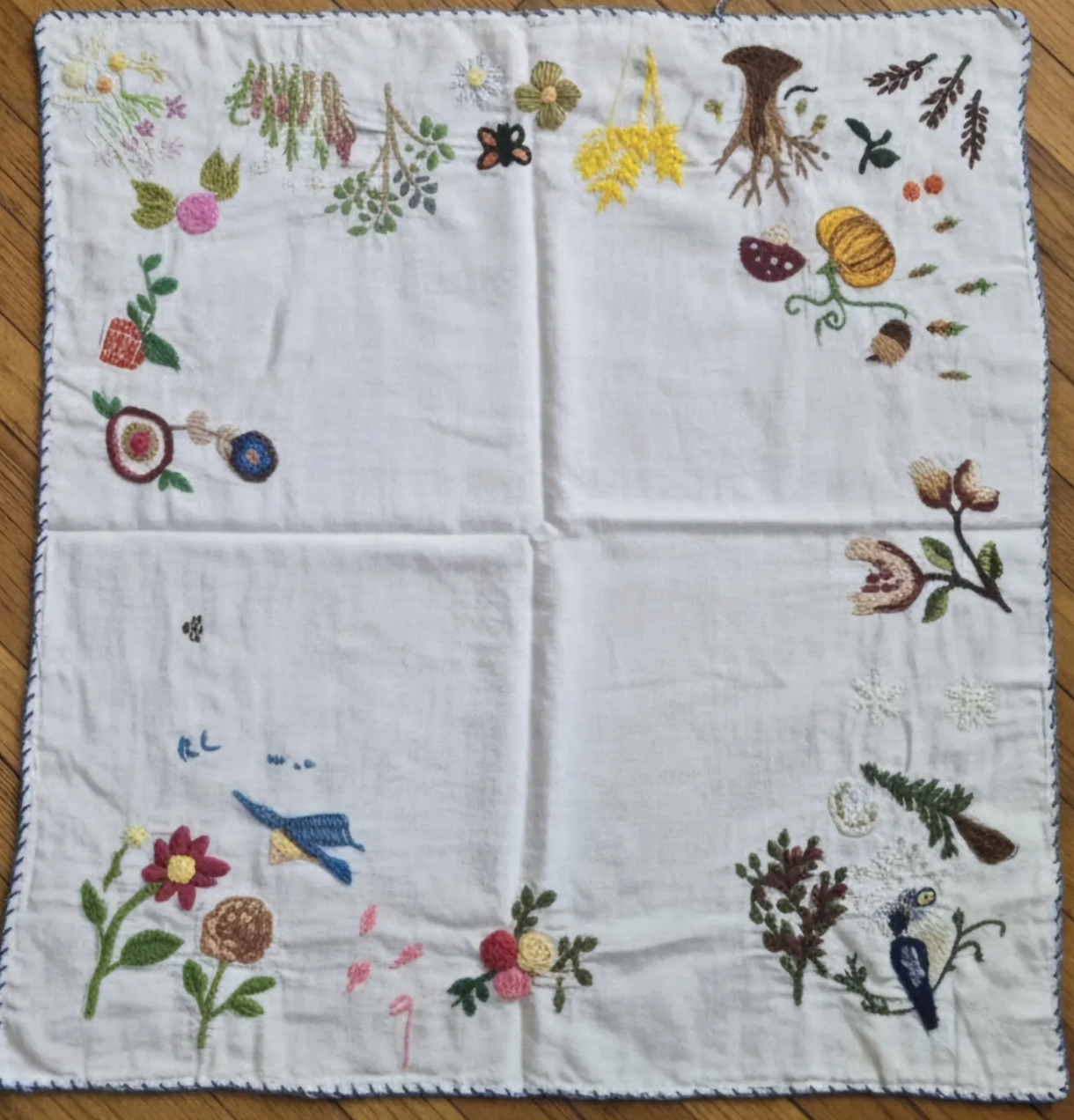
El Mantel, 2024
Ash Ernesto. Hand embroidery on cotton, 32″ x 30″
Not for sale
Generational Legacy
A space that speaks to generations of fathers, sons, and a Mixe king.
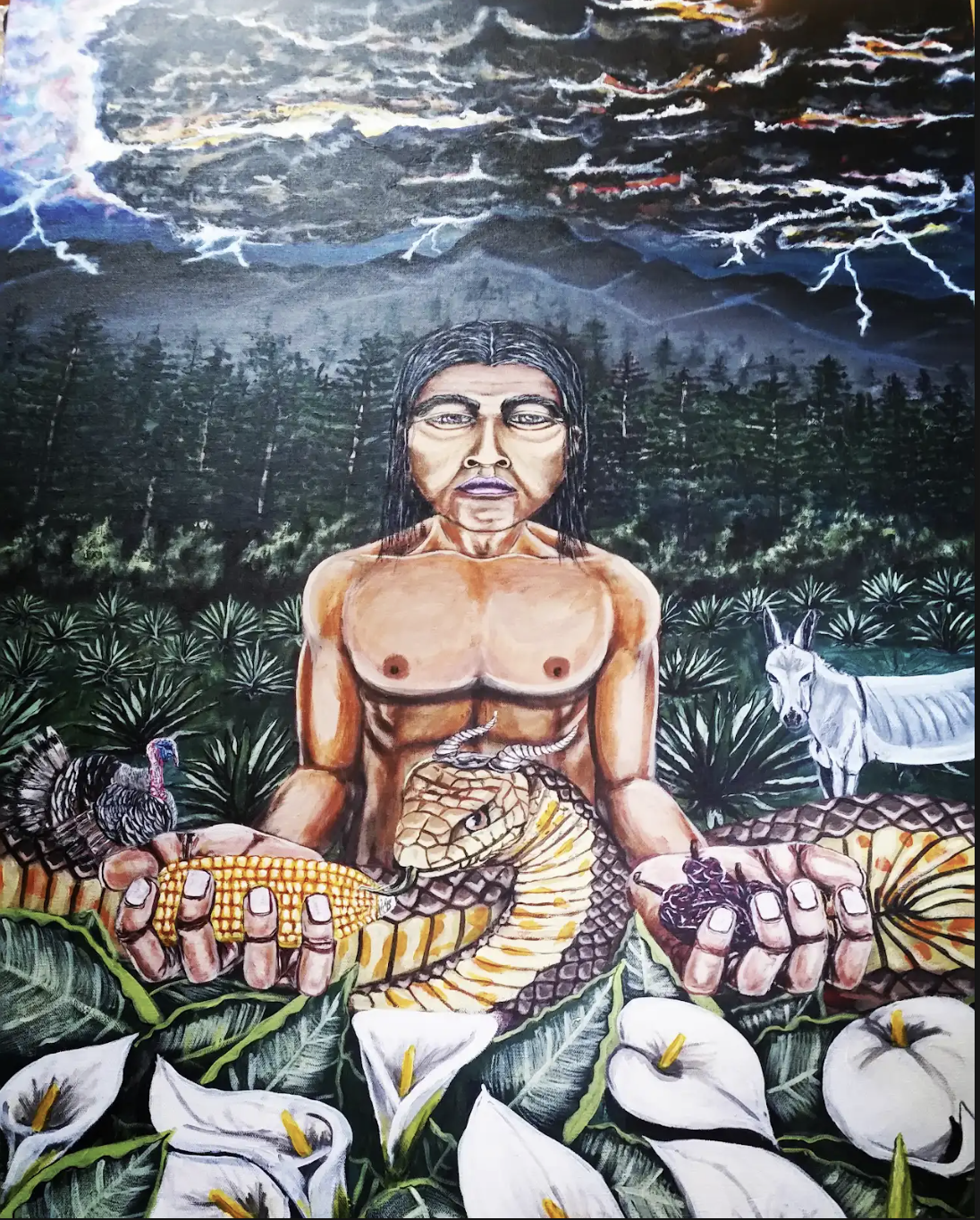
It holds the work of Anthony and Louie Brewer, a father and son who paint together, and above their corner, a painting by Conhg Lopez Ausencio, rey condoy.
I made this wall to honor the men in my life, who have been paternal, caring, and supportive, even when they could not always be around. Care is not only women’s work, and it was never only women who carried it.
On the iPad, you can watch Louie Brewer’s process, and you can see in real time how much of his father Anthony’s influence has been passed on to him: the way he explores his creativity and decides what comes next. Knowledge moving from hand to hand while you watch. The studio easel, the used palettes from each artist, the round rug, and Pepe the dog’s bed are theirs, too. This is a working studio, and it is a household.
Now look up. In Mixe tradition, King Condoy and his sister were born from the same egg. His sister, Konk Anä, went to live in the sky because she could not understand humans. Condoy stayed. He taught his people to farm and to govern themselves, and he defended them so fiercely that the Mixe still call themselves los jamás conquistados, the never conquered. When his time came, he did not die. He withdrew into the mountain Zempoaltépetl, where people say he is still present, only unseen. Look at the painting. A Mixe man with long black hair looks straight at you, calm, under a sky split open by lightning. Behind him are pine forests and mountains. He holds out an ear of corn in one hand and a handful of dark fruit in the other, the harvest he taught his people to grow. A serpent coils in front of him.
A turkey stands at his side. Conhg told me the turkey is a sacred and special food for his people, prepared for ceremonies. A thin white donkey stands on the other side. Before there were roads, he explained, the donkey was their main animal for carrying loads. At his feet grow calla lilies, the flowers Diego Rivera painted again and again, heaped in the arms of Indigenous vendors. Here, no one is carrying them. They grow at his feet, and he offers us what he holds.
A king who is also a teacher. A protector who never really leaves. Some fathers are like that. Not always in the room, and still holding up the mountain. Below him, a father teaches his son in real time. Above them, a people’s first teacher keeps watch over both.
And notice that across the house, at the dinner table, a grandson picked up his grandmother’s needle. On this wall, a son picked up his father’s paint.
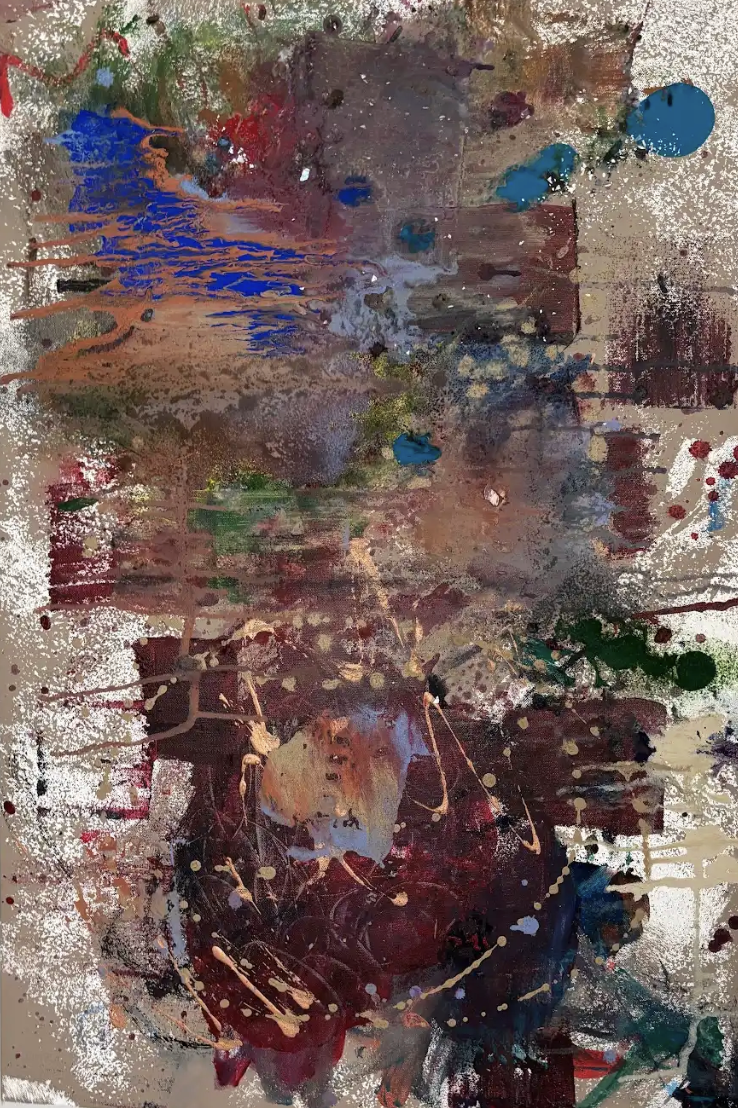
Warm Dinner, 2026
Louie Brewer. Water, Acrylic, Mixed media, 23” x 35”
Not for sale
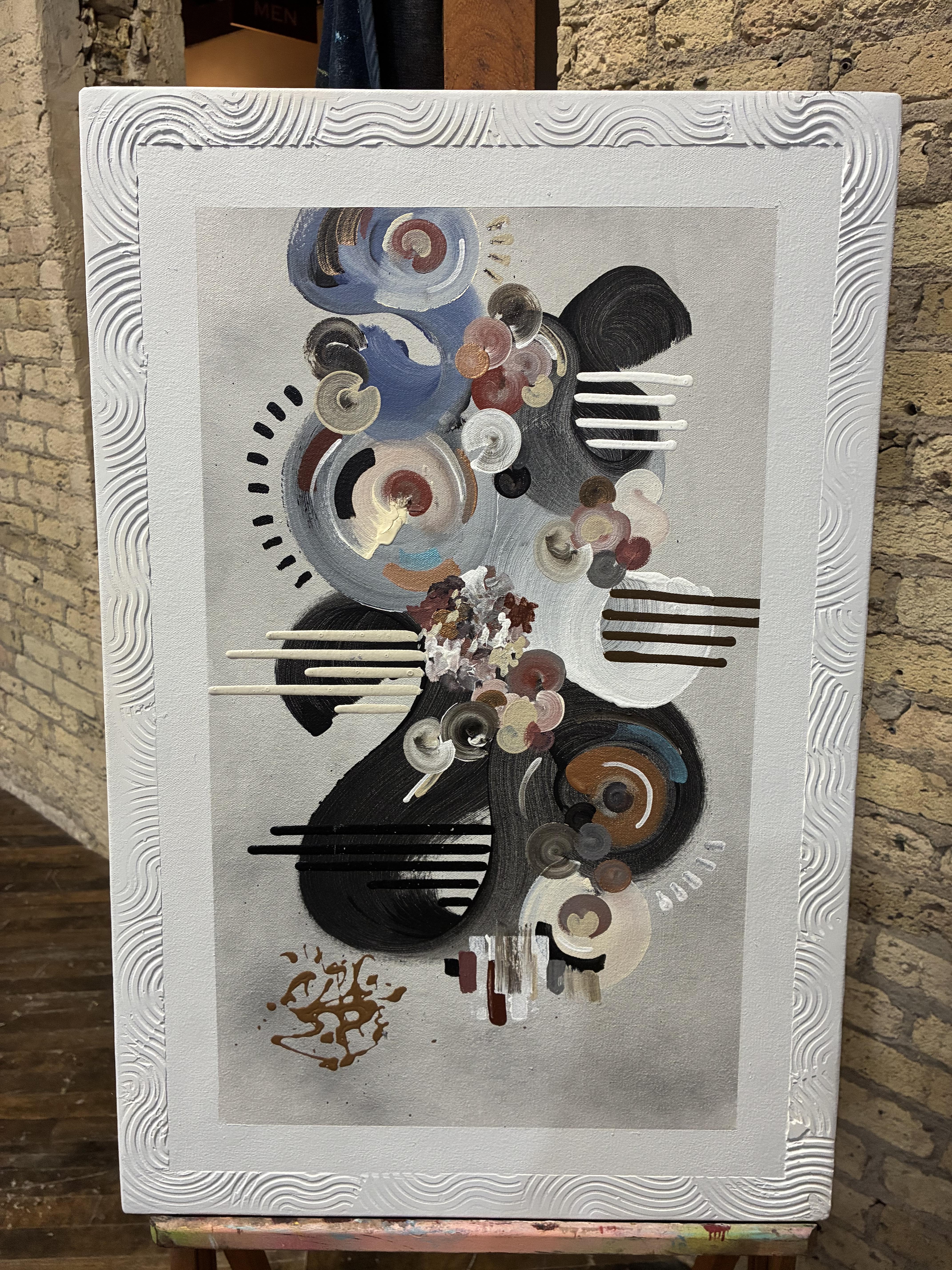
Untitled, 2026
Anthony Brewer. Mixed media, acrylic, and plaster on infrastructure canvas, 18″ x 30″
$1,100
Inquire: [email protected]
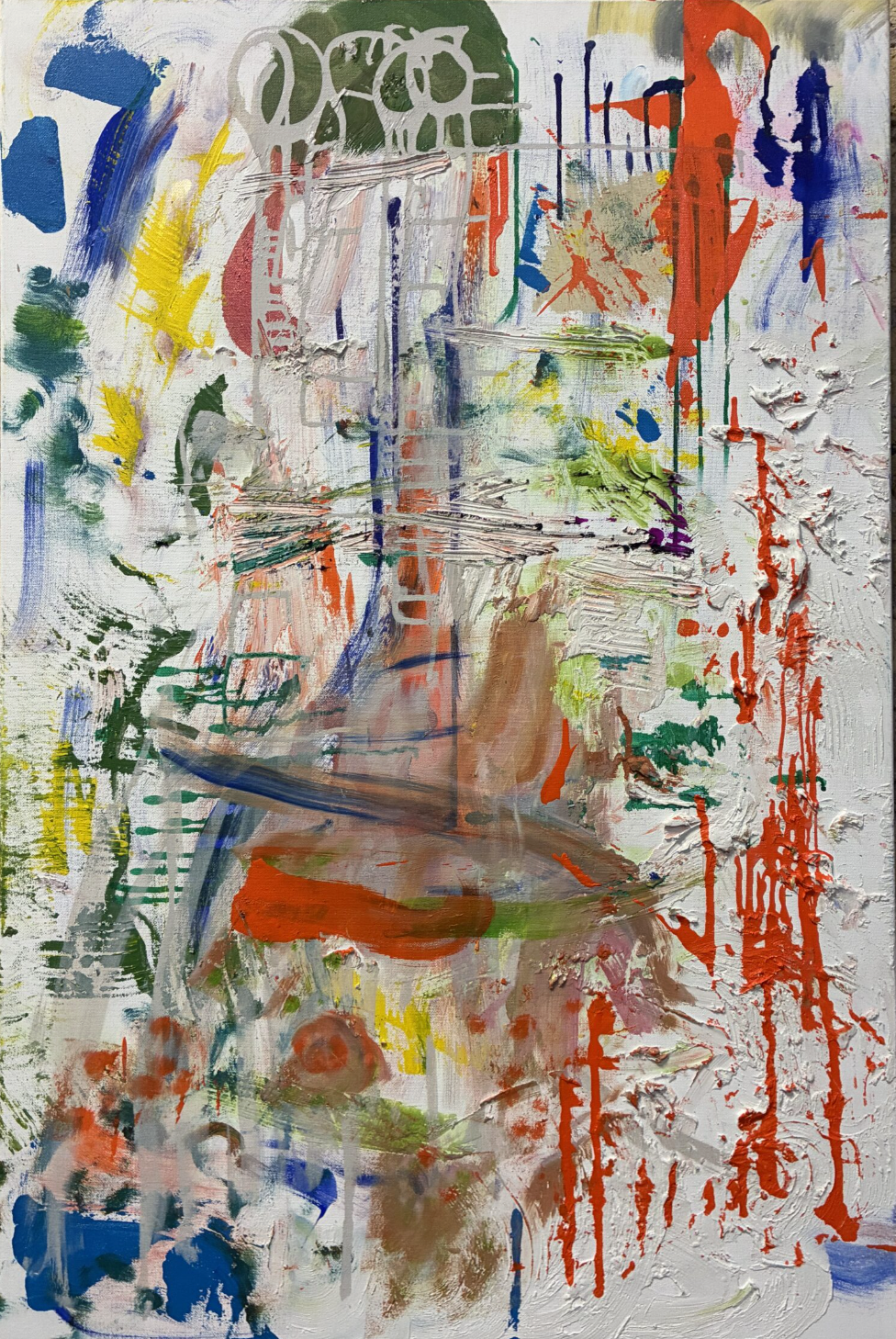
Fantastic, 2026
Louie Brewer. Water, Acrylic, Mixed media, 23” x 35”
Not for sale
Living Room
Where love and family live: dinner with dabke in the background, and portraits in hoops.
The couch faces Aida El-Hajjar’s Seeds of Love. It is a regular family dinner, and the grandparents look straight back at you. Aida told me that in her culture, everyone’s grandfather drinks laban ayran, a cold, salty yogurt drink that comes in a small red and white bottle every family knows. In the background, people are dancing the dabke.
The dabke is a line dance from the Levant, danced arm in arm, stamping the ground together. Its name comes from the Arabic word for stamping, and one of the stories of where it began is about home itself. In Palestinian villages, houses had flat roofs of packed earth, and each season the neighbors lined up, arms over shoulders, and stamped the new layer of clay into place. The work song became a dance. Today it is danced at weddings, harvests, and every kind of gathering, and in the diaspora it is one of the ways people carry the land with them. As a dancer, I love that this house holds a dance that started with building a house.
At the entrance, Aida gave us grief. Here, she gives us an ordinary dinner, and that is the point. Too often, the only way the world is willing to see Palestinians is in mourning. This painting insists on the rest of the story: the grandparents, the table, the drink, the dancing in the background. And look at the title. Love is something you plant, and someone planted it before you got here. On the coffee table you will find books about the diaspora that makes us a community. Pick one up and sit for a while.
On the dressers and stands you will see portraits by Nicole Acosta, set out the way families set out their photographs. They come from The HOOPS Project, an archive Nicole started in 2019 that has now gathered more than one hundred people from Milwaukee, Chicago, New York, Los Angeles, and beyond, from Black, Brown, Indigenous, Asian, and other global majority communities. Each portrait holds a story about hoop earrings: who gave them to you, who told you to take them off, and why you put them back on. The project has grown into a stage play and a book in progress. In Nicole’s words, “The hoops are the thread. The stories are the medicine.”
Hoops have been worn by our mothers and grandmothers for generations. On our bodies they have been called too loud, too much, and unprofessional. On other bodies, they get called fashion. Nicole’s portraits treat them as what they are to us: an inheritance, a kind of armor, and a way of saying I am here. These portraits also mark the line between the living room and the bedroom. The family is watching the door.
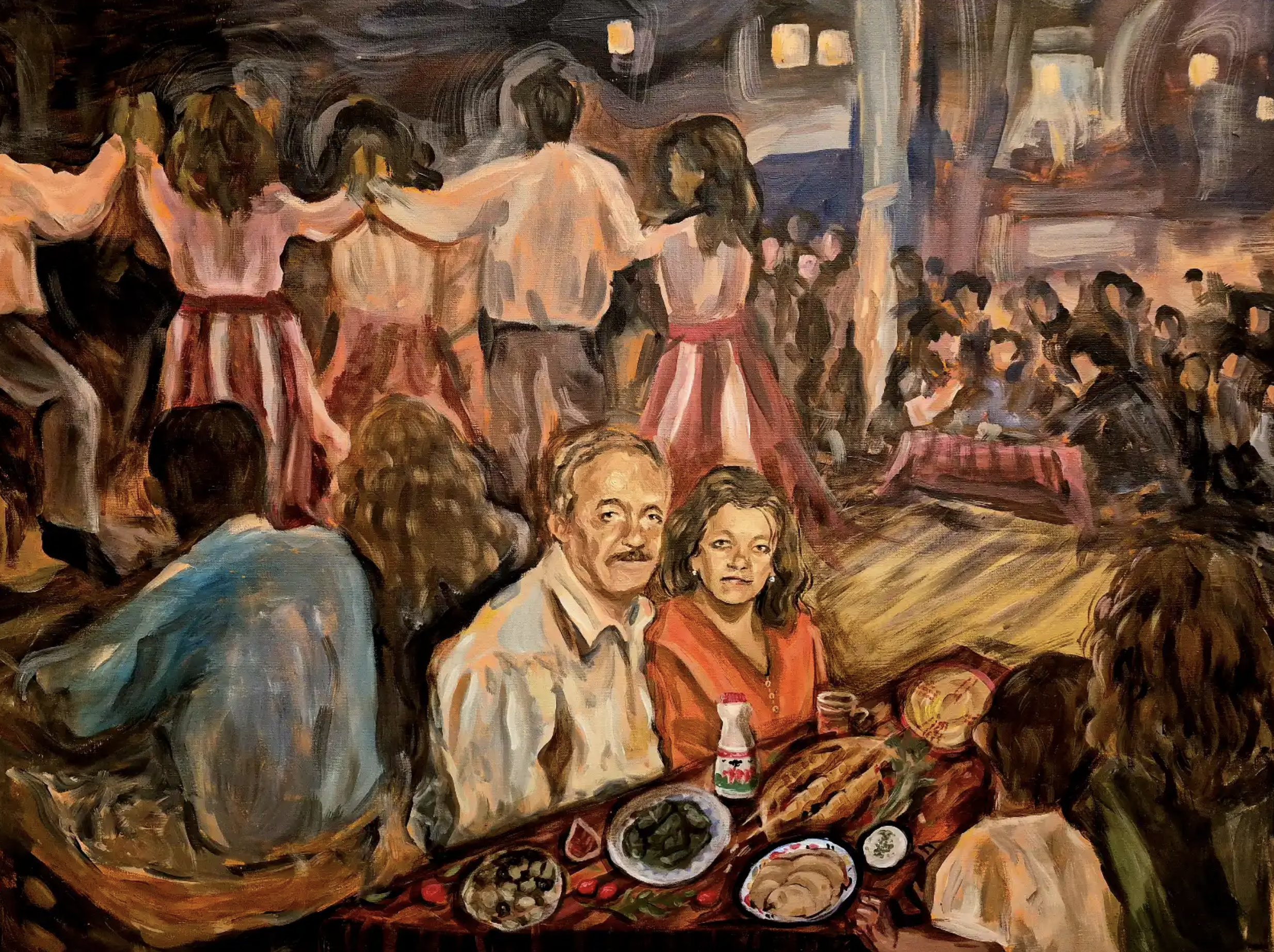
Seeds of Love, 2026
Aida El-Hajjar. Acrylic, 30″ x 40″
Not for sale

Lisette, 2022
Nicole Acosta. Photography, 4″ x 7″
Not for sale
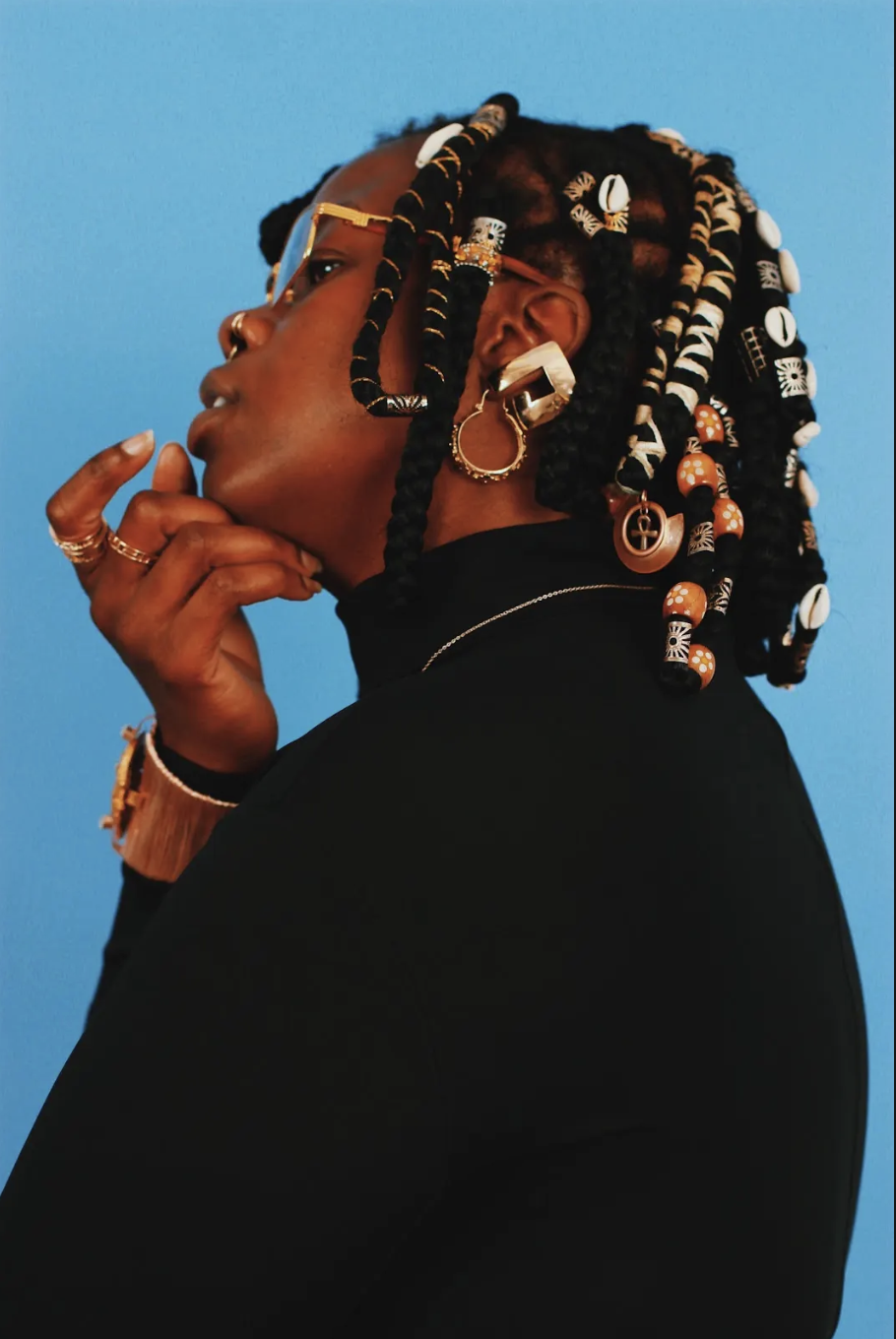
Nneka, 2022
Nicole Acosta. Photography, 4″ x 7″
Not for sale

Mya, 2022
Nicole Acosta. Photography, 4″ x 7″
Not for sale
Bedroom
The most vulnerable room in the house, resting in plain view. A quilt made from family clothing, a phone for what you have never said out loud, and a mirror that puts you in the family photos.
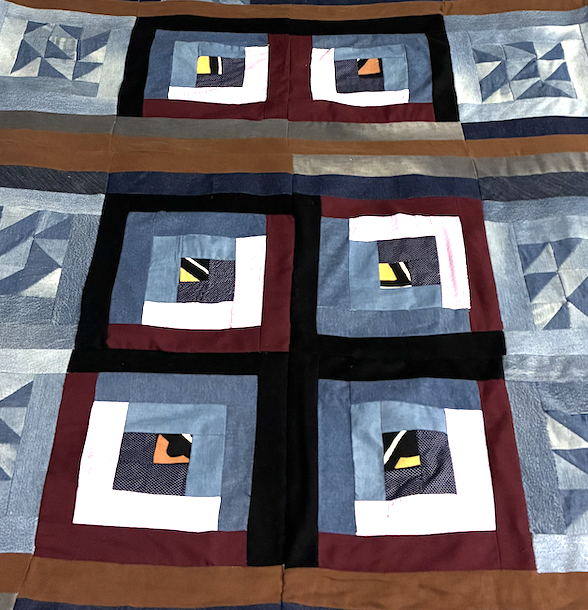
On the bed is Shana Lucas’s quilt, Plain View. Shana comes from generations of seamstresses, and she pieced this quilt from her family’s own clothing. One of the patterns she used is the log cabin. Black oral history holds that during the Underground Railroad, a log cabin quilt in sight meant this house was safe, and the people inside were safe to speak with. Some historians have questioned it because it was never written down. But who was free to write it down? People escaping slavery and the people hiding them had every reason to leave no record. What survived, survived in families, passed hand to hand, the way this quilt was.
Now look at what the quilt is resting on. This bed is an air mattress, the bed you blow up when someone needs a place to stay, when a family is between homes. A quilt that says this house is safe, lying on the bed of displacement, in a house that will be sold off on November 1.
And not every road to freedom ran north. Mexico abolished slavery in 1829, under President Vicente Guerrero, a man of African and Indigenous descent. Thousands of enslaved people in Texas escaped south across the Rio Grande. Keep that in mind when you reach the ofrenda and Ash’s El Desierto. It is the same border, crossed in the other direction, toward freedom.
Above the bed hangs Clytie, by my brother, Ash Ernesto, in oil and textile. In the Greek myth, Clytie loved the sun god Apollo, and he did not love her back. She sat on the ground watching him cross the sky until she turned into a flower that follows the sun. People escaping slavery followed a light in the sky too, the North Star. Clytie spent her devotion in plain view, and the one she watched never looked back. So much of our labor lives the same way, holding everything together and still unseen.
Here in the bedroom is Conhg Lopez Ausencio’s Quetzalcoatl, a woodblock print on fabric. In the Leyenda de los Soles, the Mexica tell how people came to be. After the world had ended and begun again, there were no people left in it.
Quetzalcoatl, the feathered serpent, went down to Mictlan, the land of the dead, to recover the bones of those who had lived before. Mictlantecuhtli, the lord of the dead, tried to trick him. Quetzalcoatl took the bones anyway, but as he ran he fell, and the bones broke and scattered. That, the story says, is why people come in all different sizes. He carried what was left to Cihuacoatl, the serpent woman, who ground them on her metate the way corn is ground for masa, and Quetzalcoatl bled over the flour. From that dough, people were made. It took a journey through the land of the dead and a woman at a grinding stone to bring his people home. In the bagua map, this corner belongs to love and partnership. This is where life begins.
Now stand at the foot of the bed and look into the oval mirror on the vanity. You will see yourself between two portraits by Nicole Acosta: one from The HOOPS Project, and her own quinceañera photograph, a girl on the edge of becoming who she is. Her hoops rest in front of you. The quilt holds Shana’s family, and the vanity holds Nicole’s. The whole room is a family album, and for a moment, you are in it too.
On the side table is a phone. Pick it up. You are welcome to leave an anonymous message, or just say the thing you never got to say. The quilt says the people here are safe to speak with. But this is still the most private room in the house, and you are in plain view of everyone on the outside path. That says a lot about how hard it is to share our deepest thoughts when we are always being watched. So if you can, say it anyway.

Julia, 2022
Nicole Acosta. Photography, 4″ x 7″
Not for sale
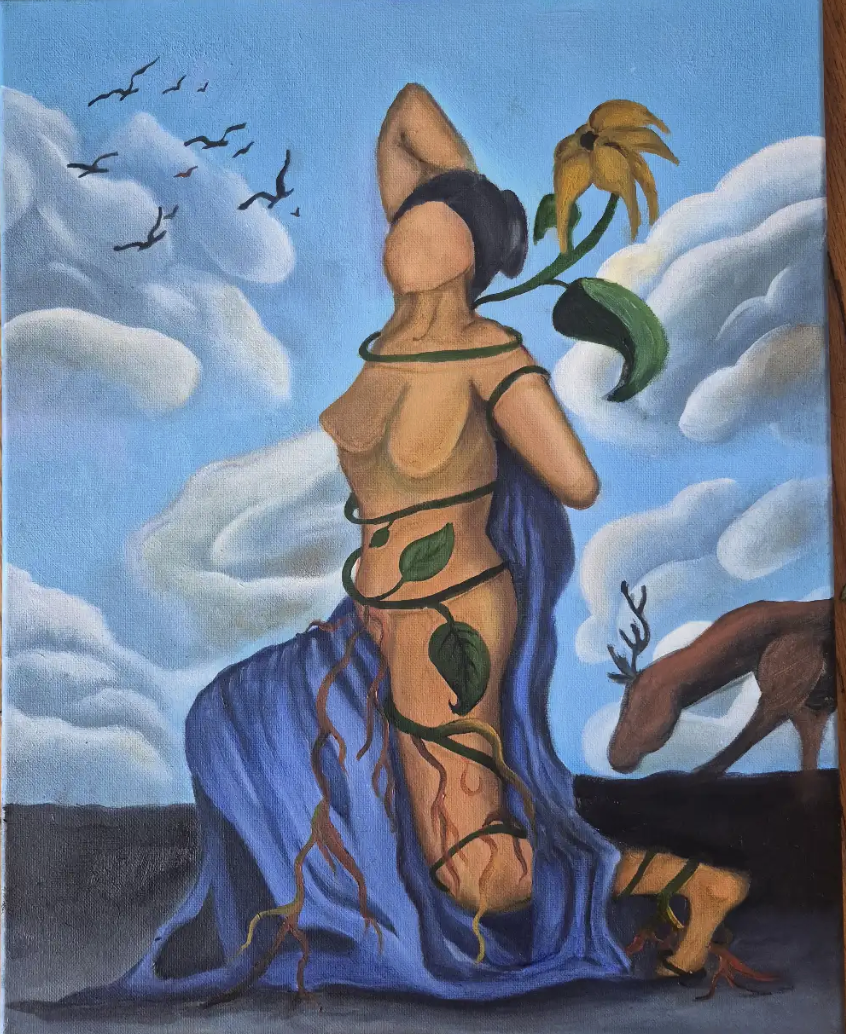
Clytie, 2026
Ash Ernesto. Oil and textile on canvas, 20″ x 16″
Not for sale
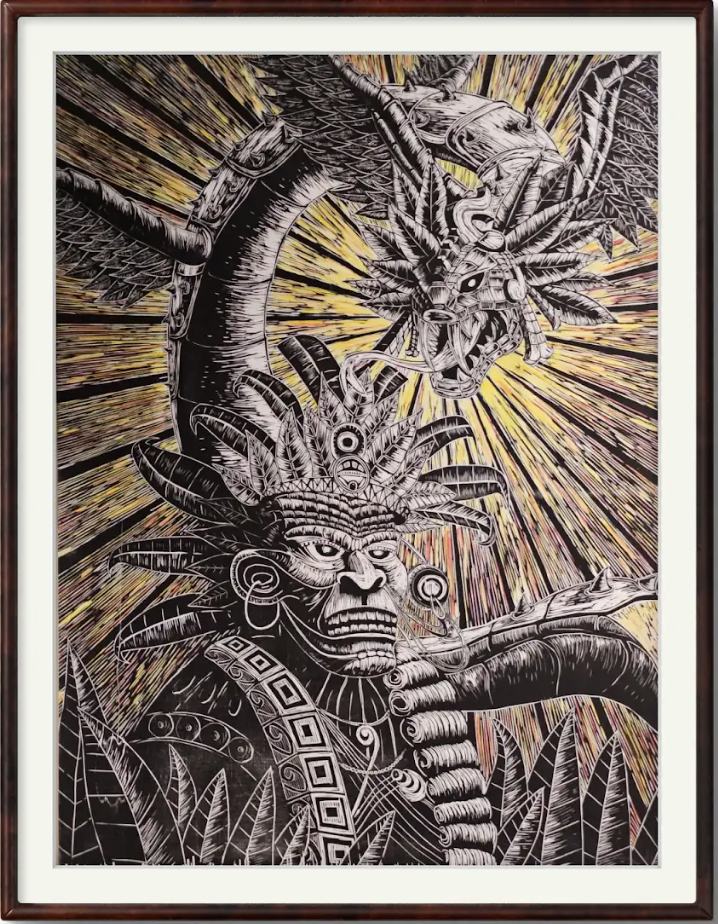
Quetzalcoatl, 2024
Conhg Lopez Ausencio. Woodblock print on fabric, 36″ x 48″
$1,200
Inquire: [email protected]
Back of the House
Unacknowledged Labor & Revolutions
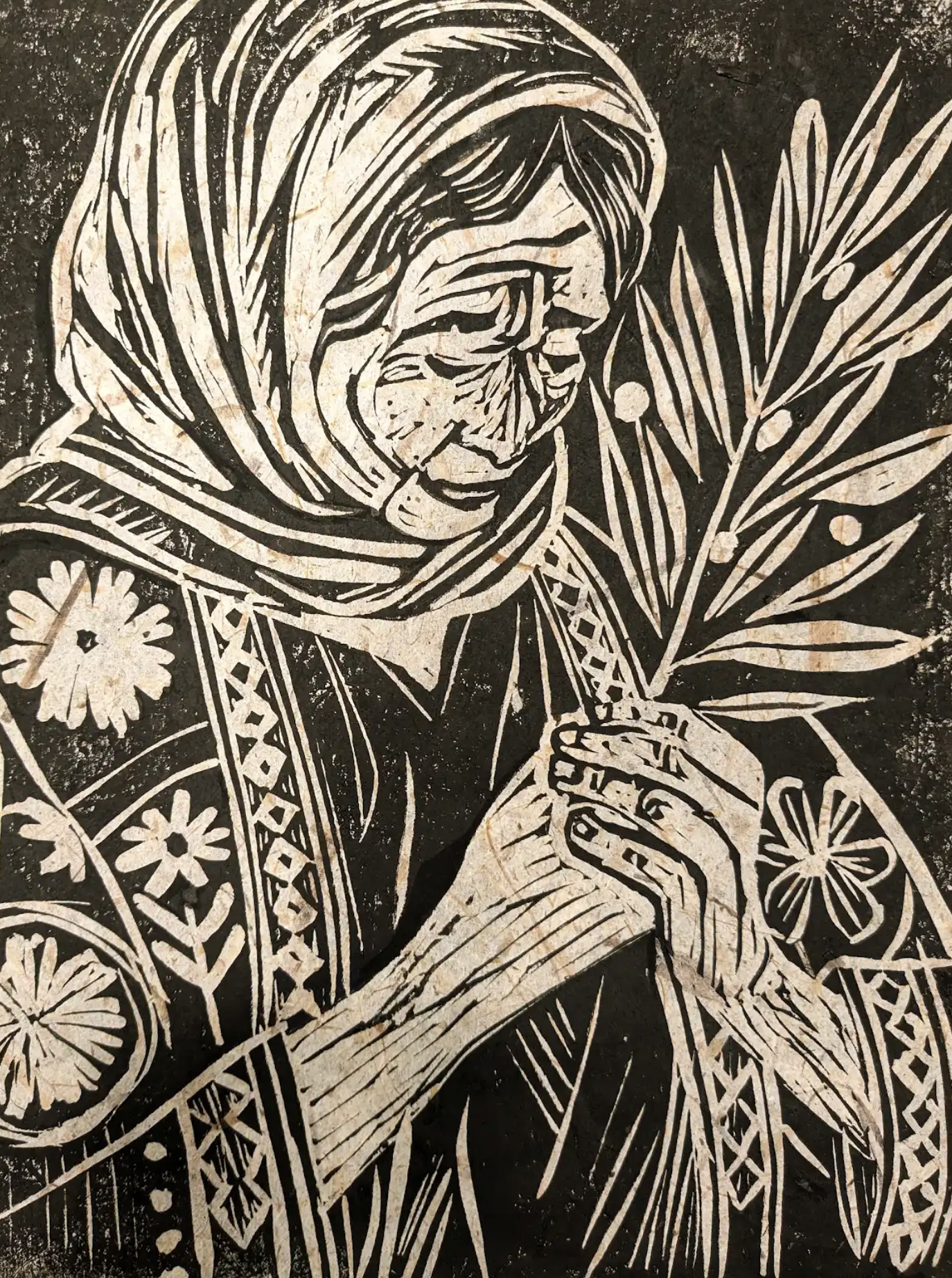
An Ofrenda
For our ancestors, for families torn apart by a border, and for those we will meet again.
On the altar is Ash Ernesto’s El Desierto, painted in acrylic, with touches of gold. Look at the group of cacti. Ash told me they are a family, and that they represent us, our family. But in this space, they honor entire families that have been torn apart over a border that insists on dividing us, and the people who lost their lives on the journey. In religious icons and retablos, gold is what marks something as sacred. Here, that gold is given to the desert, and to the ones who never made it across.
Hanging in the center of la Ofrenda is Ash’s Montessori chair, Herencia, which means heritage. It is a small wooden chair, and painted on are a montage of Frida Kahlo’s paintings. Ash used real objects suchs as scissors, and real flowers to give the piece texture. And to bring out Frida’s hair, he used mine. So part of me is on this altar, too.
Frida turned pain that was supposed to stay private into something the whole world had to look at. On an altar for the people we have lost, she stands in for the women whose suffering was never counted, and for the ones who painted it anyway.
Conhg Lopez Ausencio’s mi cultura, my culture, lives here too. It is a black and white woodblock print with one color: a red star. Look at the face in the center. It is split down the middle. The left half is a living man, bearded, with one eye open and looking right at you. The right half is an ancestral mask, carved like stone, with a ringed eye and fangs like Tláloc. That is what culture feels like from the inside: the person you are today, and everyone who came before you, sharing the same vessel.
Across the top runs the stepped fret pattern from the walls of Mitla, in Oaxaca. The name Mitla comes from the Nahuatl Mictlan, the place of the dead, the same land of the dead Quetzalcoatl crossed in the bedroom to bring his people home. Around the face, Conhg carved the animals that belong to this altar. There are two hummingbirds; the Mexica believed fallen warriors came back as hummingbirds. There is a grasshopper, a chapulín, and in the corner sits a hairless dog, a xoloitzcuintle, the dog who guides the souls of the dead across to Mictlan. Behind it all, the red star, a symbol of revolution that in southern Mexico belongs to the Zapatistas.
In Mexico, black and white relief printing has long been an art of the people: affordable to make, easy to share, passed from hand to hand and pasted on the walls of the street.
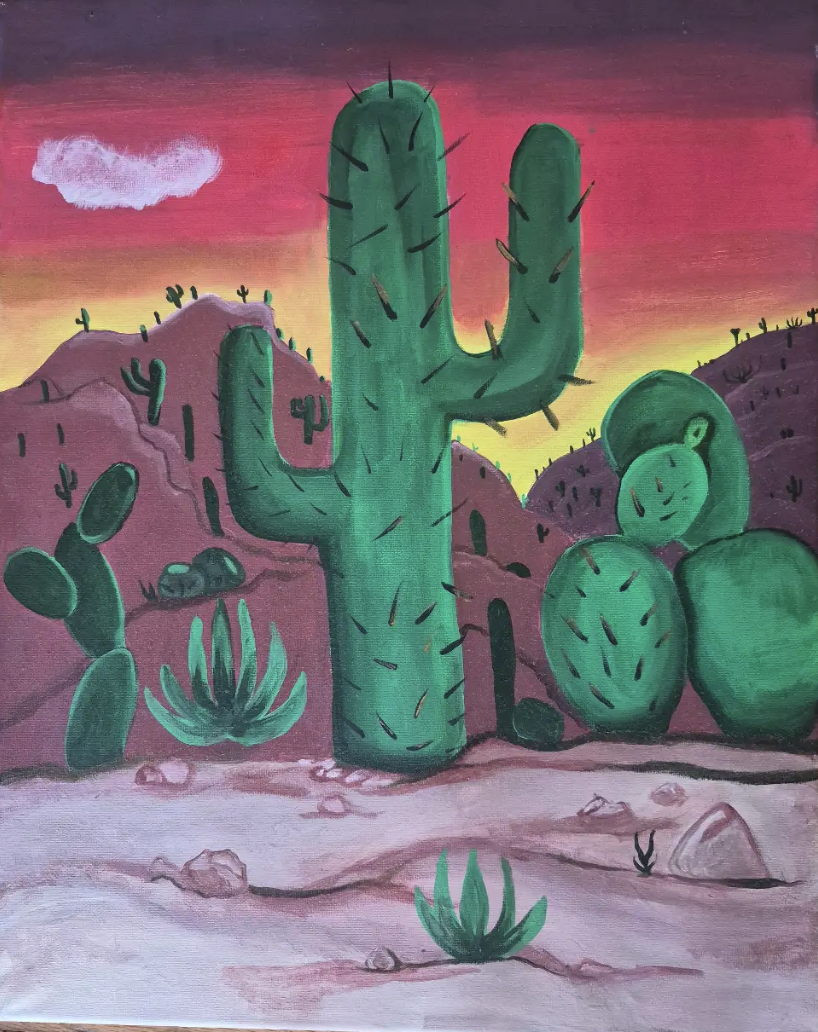
El Desierto, 2025
Ash Ernesto. Acrylic and gold acrylic on canvas, 20″ x 16″
Not for sale
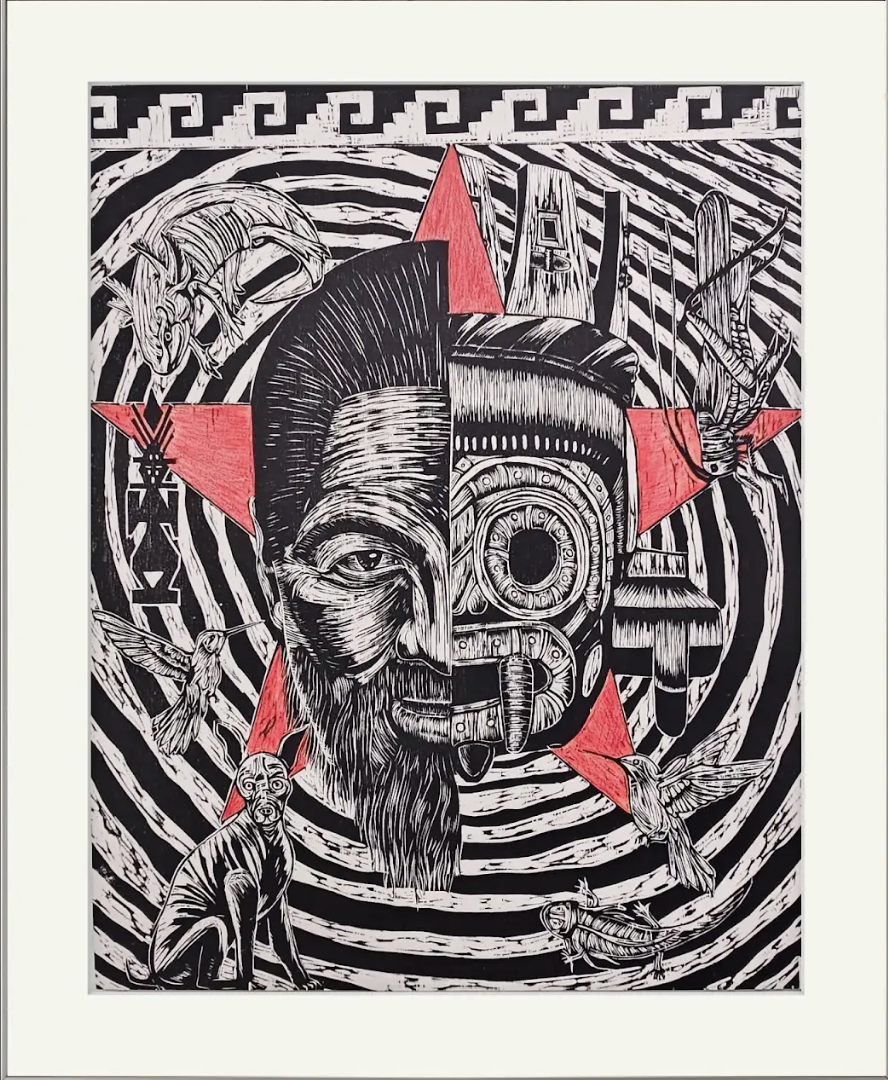
mi cultura, 2024
Conhg Lopez Ausencio. Woodblock print on paper, 22″ x 28″
$450
Inquire: [email protected]
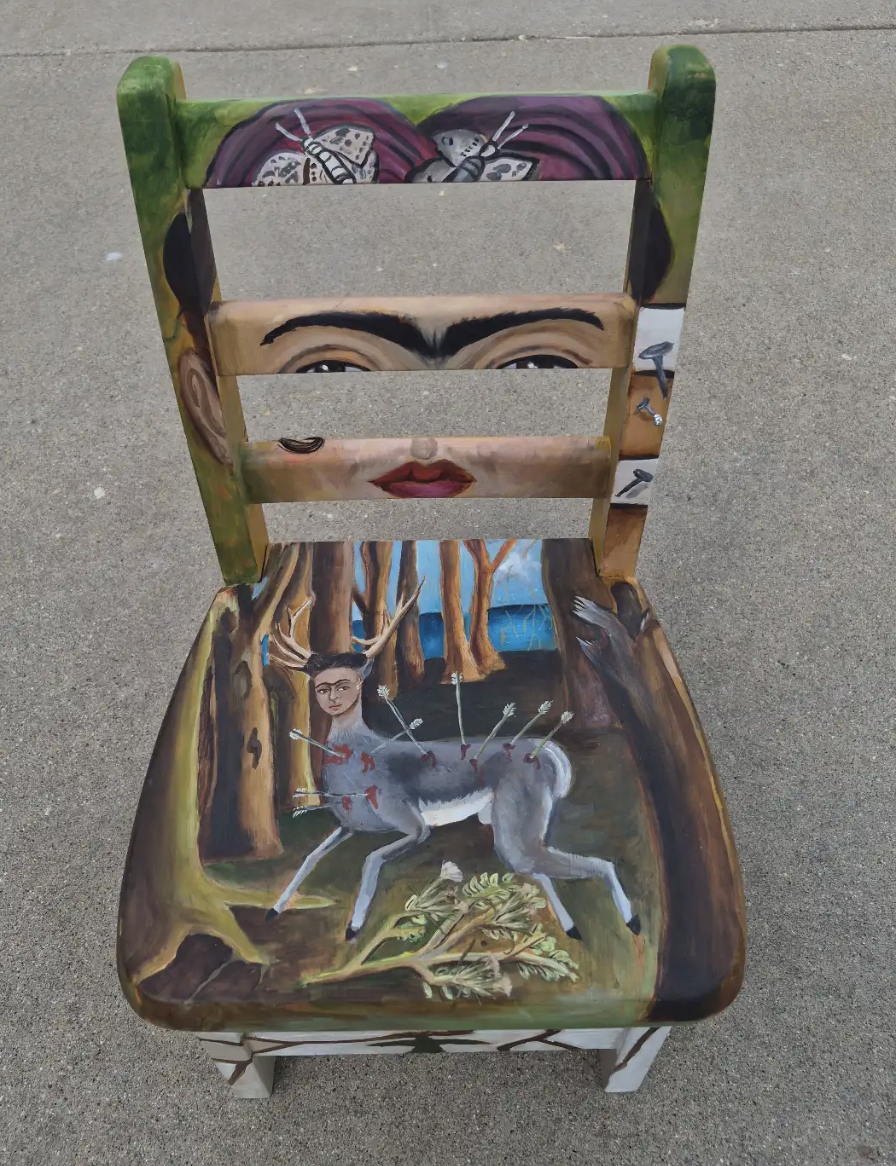
Herencia, 2026
Ash Ernesto. Multimedia on wooden Montessori chair, 24″ x 14″ x 15″
Not for sale
Programming
Opening Night, Friday, October 2. Gallery Night MKE, Friday, October 16. Mercadito Day, Sunday, November 1: the closing, run as an estate sale, where the furniture and objects that built the house are sold and the home comes apart.
HOME asks what it means to build something and have it taken from you. I did not have to look far for the answer.
I gave this space two years of high-level work on a mennial retainer, waiting on a promised salary that never came. When I began to burn out and set boundaries, the warmth went away. I was left out of conversations and met with a coldness that made it feel unsafe to say anything, so I let it pass. Then I was told to stop working indefinitely, for lack of funds. A month later, I was formally let go because he felt I was “taking advantage of him.” I stayed anyway, in whatever capacity I could, as an artist, waiting on a studio promised to me in writing, after having my mother invest in the building. I waited six months in anticipation that our studio would finally be taken care of but when we began conversations about it, we were suddenly “no longer a good fit for the space” and we were wished the best of wishes.
Most spaces are built with a certain community in mind, even the ones that call themselves open, progressive. Even an art house. Our music and our dance never quite fit the picture here. We are welcomed for our labor and our ideas, then shown the door when we ask for what is ours. That feeling of not belonging follows us into schools, workplaces, neighborhoods, and galleries, even at home. It is one of the oldest stories in our lives.
As a volunteer on the gallery’s committee, I chose the way I wanted to leave. With a house full of Black and Brown artists, and the truth inside the walls that would not make room for us.
With no budget, a lot of research, and a few helping hands, I did what our families have always done. Build a home anyway. On my terms. And when it closes, it moves on, the way so many of us have had to, and will build again somewhere with room for all of us.
Sources and References
Baumgartner, Alice L. South to Freedom: Runaway Slaves to Mexico and the Road to the Civil War. New York: Basic Books, 2020.
Bryant, Marie Claire. “Underground Railroad Quilt Codes.” Folklife, Smithsonian Center for Folklife and Cultural Heritage, May 3, 2019. https://folklife.si.edu/magazine/underground-railroad-quilt-codes.
Du Bois, W. E. B. The Souls of Black Folk. Chicago: A. C. McClurg, 1903.
Espinoza, Dionne, María Eugenia Cotera, and Maylei Blackwell, eds. Chicana Movidas: New Narratives of Activism and Feminism in the Movement Era. Austin: University of Texas Press, 2018, 2. Quotations and page number as given in Richard Cruz Davila’s review in Nexo (Julian Samora Research Institute, Michigan State University), Spring 2019.
Kahlo, Frida. Self-Portrait with Cropped Hair, 1940; The Wounded Deer, 1946.
Kitchen Table: Women of Color Press, founded 1980. Smith quotation via https://en.wikipedia.org/wiki/Kitchen_Table:_Women_of_Color_Press; see also Barbara Smith, “A Press of Our Own,” Frontiers 10, no. 3 (1989).
Legend of King Condoy. https://www.viveoaxaca.org/2020/06/LeyendaReyc.html.
Leyenda de los Soles: Quetzalcoatl, Mictlan, and Cihuacoatl. https://www.mexicolore.co.uk/aztecs/stories/origin-of-people.
“Mexicans,” “Bronzeville,” and “Cream City Brick.” Encyclopedia of Milwaukee, University of Wisconsin–Milwaukee. https://emke.uwm.edu.
Michelangelo. Pietà, 1498 to 1499. St. Peter’s Basilica.
Ovid. Metamorphoses, book 4: Clytie and the sun god. Ovid names him Sol (Helios); later retellings name Apollo.
“Palestinian Dabke: History, Steps & Meaning.” Falastin. https://falastin.me/blogs/discover-palestinian-traditions/palestinian-dabke-history.
Rivera, Diego. Calla Lily Vendor, 1943.
“Ayran.” Wikipedia. https://en.wikipedia.org/wiki/Ayran.
43 Voices (2015). https://pamnanet.com/43-voices-exhibition/.